
If you have been trying to decide between the CeraVe Skin Renewing Night Cream and the Olay Regenerist Micro-Sculpting Cream, the short answer is this: they are built on genuinely different philosophies, and the one that works better for you depends almost entirely on what your skin is asking for. CeraVe is about restoring the barrier with peptides and ceramides. Olay leans into a retinoid-adjacent approach with retinyl propionate and niacinamide. I have used both back to back over two separate six-week stretches, and they do not feel interchangeable at all.
Price is close enough that it should not be the deciding factor. The texture difference, the fragrance situation, and what each formula is actually designed to do are what matter. Let me walk through both in detail so you can make a clear-headed call rather than just buying whichever one has better photography on the Amazon listing.
| Feature | CeraVe Skin Renewing Night Cream | Olay Regenerist Micro-Sculpting Cream |
|---|---|---|
| Price Tier | Budget for 1.7 oz | Mid-range for 1.7 oz |
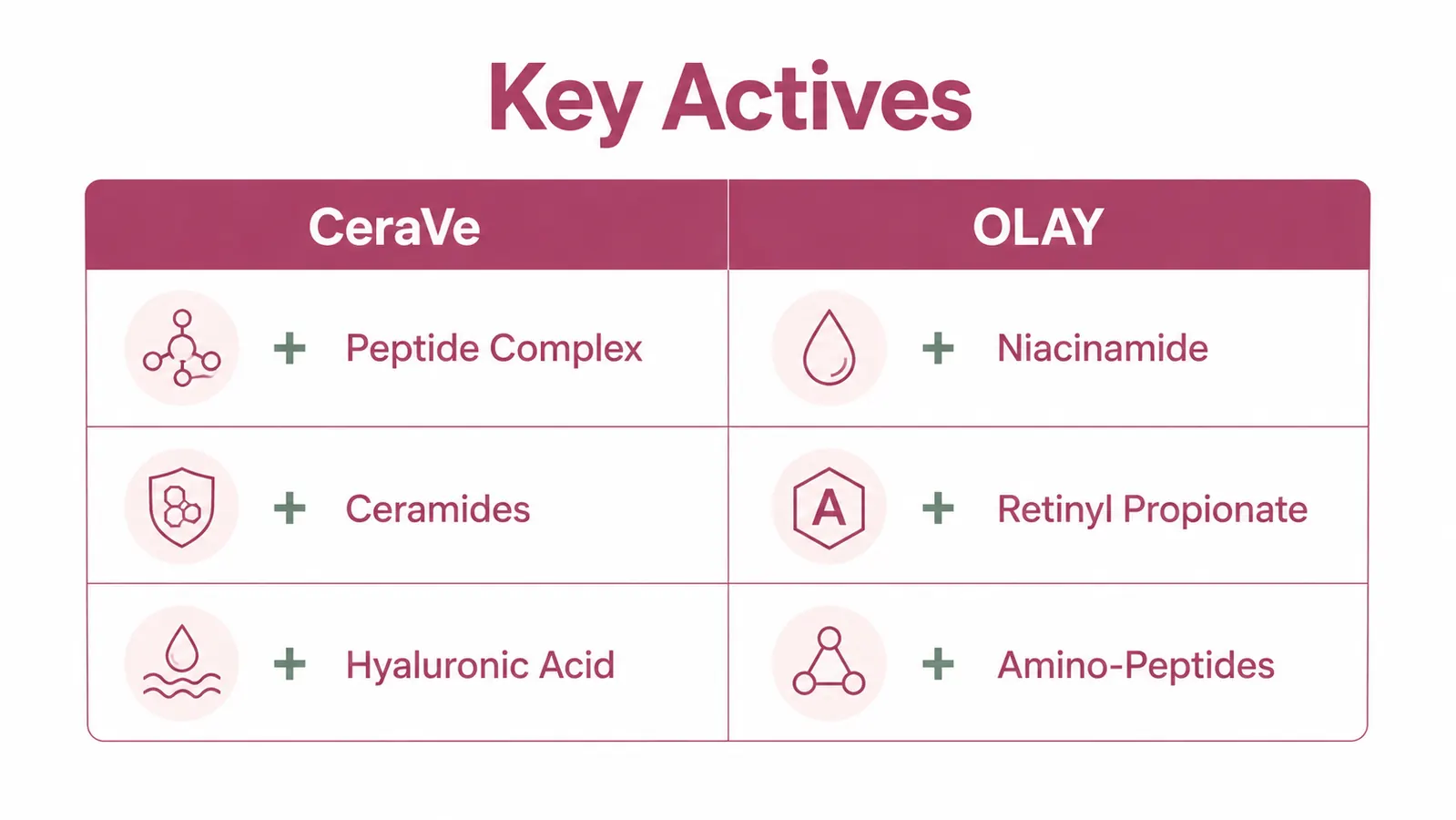
| Key Actives | Peptide Complex, three Ceramides (1, 3, 6-II), Hyaluronic Acid | Niacinamide, Retinyl Propionate, Amino-Peptides, Hyaluronic Acid |
| Texture | Soft gel-cream, absorbs in 60-90 seconds, no residual film | Richer and denser, slight tackiness on first application |
| Fragrance | Fragrance-free | Light floral-adjacent scent |
| Skin Barrier Focus | Primary focus: ceramides replenish lipids that hold moisture in the skin | Secondary; hyaluronic acid handles hydration but not barrier lipid repair |
| Vitamin A Activity | None | Yes, via retinyl propionate (mild, lower irritation than retinol) |
| Best For | Dry, sensitive, or barrier-compromised skin of any age | Normal to combination skin focused on tone and surface texture |
| Dermatologist-Developed | Yes | No (Olay R&D) |
| Safe With Prescription Retinoids | Yes, CeraVe pairs well and helps offset retinoid dryness | Use caution; retinyl propionate on top of a separate retinol increases irritation risk |
If your skin is dry or reactive, the CeraVe formula addresses what is actually causing it.
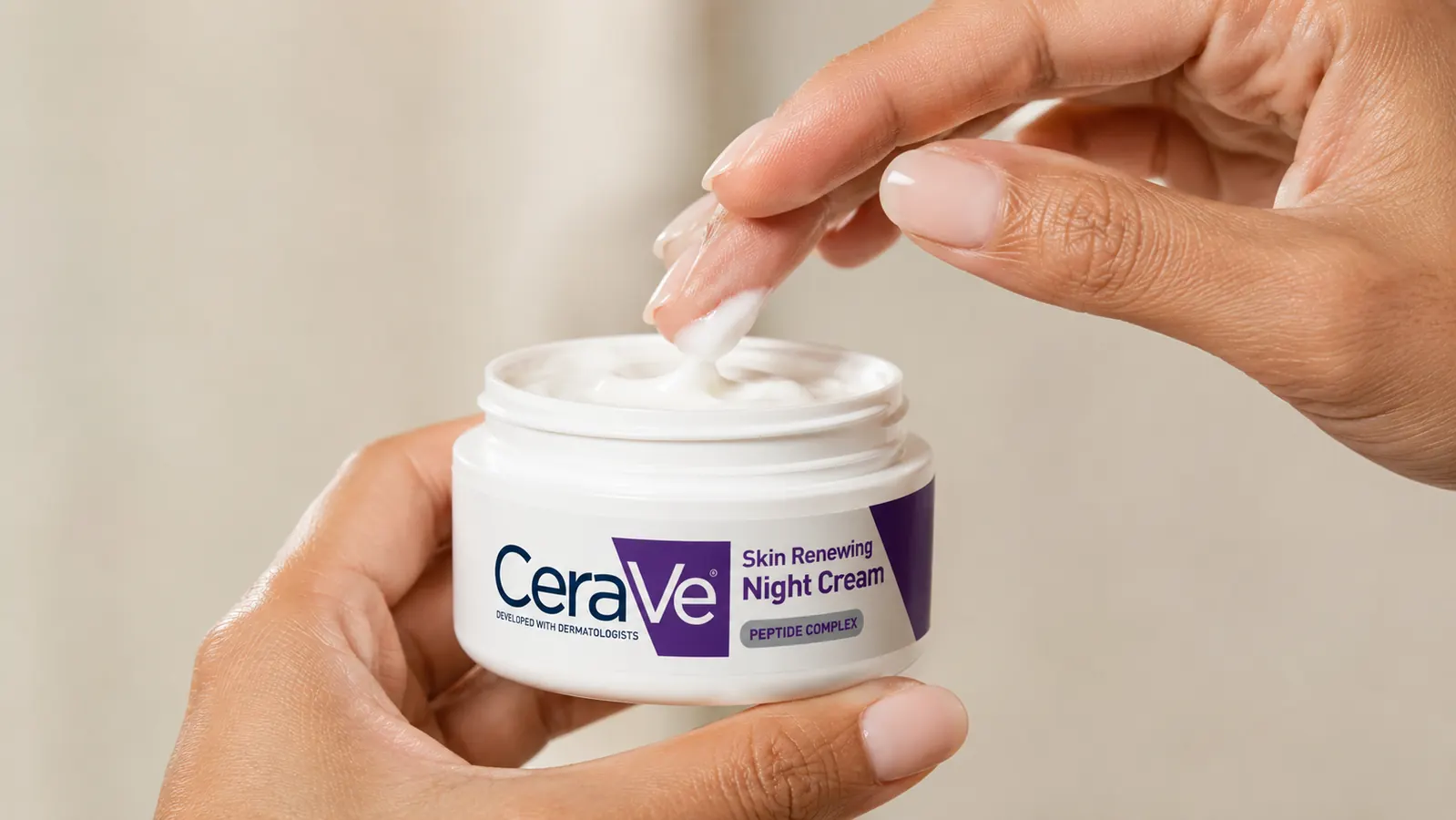
The CeraVe Skin Renewing Night Cream is fragrance-free, formulated with three ceramides and a peptide complex, and works overnight without sitting heavy on your face. It has over 56,000 Amazon reviews and a 4.6-star rating.
Amazon Check Today's Price on Amazon →What Each Formula Is Actually Doing
The fundamental difference between these two creams comes down to mechanism. CeraVe works by replenishing the ingredients that make up a healthy skin barrier: ceramides are the lipids that form the protective layer of the stratum corneum, and when that layer is depleted, water escapes faster than skin can replace it. No matter how much moisturizer you apply on top, a compromised barrier will keep losing moisture. The ceramide-plus-peptide strategy is about solving the structural problem directly.
Olay Regenerist takes a different approach. It uses retinyl propionate, a vitamin A ester that converts to retinoic acid in the skin at a slower and milder rate than standard retinol, alongside niacinamide, which regulates sebum, reduces the appearance of pores, and helps even out patchy pigmentation over time. Where CeraVe works on the barrier itself, Olay works on the surface. It encourages cell turnover and tries to improve the evenness and texture of what you see. Neither goal is wrong. They are just aimed at different problems.
Where CeraVe Wins
The biggest advantage CeraVe has over Olay is the specificity of its barrier repair. It puts three ceramides front and center in the formula: ceramide 1, ceramide 3, and ceramide 6-II. These are the same ceramide types found naturally in healthy skin, and they are positioned high in the ingredient list, meaning there is enough of them to do something real. Add a peptide complex that signals the skin to support its own structural proteins and you have a formula that is actively working on what most people with dry or sensitive skin actually need.
I noticed this distinction most clearly during a cold-weather stretch last February. I ran six weeks on CeraVe, then switched to Olay for six weeks, then came back. On CeraVe, my skin felt stable by morning and did not need any additional oil or balm on top. On Olay, I found myself reaching for a facial oil twice a week because the product, while pleasant and well-formulated, was not addressing the barrier piece. That is not a flaw in Olay. It is just not what it was designed to do.
The other clear win for CeraVe is fragrance. It has none, full stop. That matters more than people give it credit for. If you are using an exfoliating acid at night, a prescription retinoid, or any active that already puts a mild load on your skin, layering a scented moisturizer on top adds a variable you do not need. Fragrance is a common trigger for redness and sensitivity in people who would not describe themselves as having reactive skin, because the reaction tends to build gradually rather than showing up immediately. CeraVe removes that question entirely.
Where Olay Wins
Olay Regenerist has two things going for it that CeraVe does not: retinyl propionate and niacinamide. The retinyl propionate is the more important one for people who want some level of vitamin A activity without committing to a prescription retinoid or a high-percentage over-the-counter retinol. It provides mild, consistent surface renewal with a lower irritation profile. For someone in their late 20s or 30s who is just starting to think about skin texture and wants a gentle entry point, the Olay is a sensible choice because the vitamin A effect is baked into the moisturizer rather than requiring a separate serum step.
Niacinamide is the second meaningful edge. At functional concentrations, niacinamide reduces redness visibly, minimizes the look of enlarged pores, and helps even out discoloration caused by past breakouts or sun exposure. CeraVe's night cream formula does not include it. If you have combination or oily skin where pore size and tone are your primary concerns, rather than moisture retention, the Olay addresses that in a single step. The texture is also richer and more traditional for people who find the CeraVe gel-cream feel a little too lightweight.
CeraVe does not try to do everything overnight. It does one thing exceptionally well: keep the skin barrier intact so all the other steps in your routine can actually land.
Texture and Wear: What to Expect
These creams feel very different on the skin, and that is worth knowing before you order. The CeraVe Skin Renewing Night Cream has a soft, whipped gel-cream texture that absorbs within about 60 to 90 seconds. There is no film on the face after it sinks in, which means it works under a sheet mask if you are someone who occasionally does that, and it does not transfer onto a pillow in a way that is noticeable in the morning. For people who sleep warm or who have combination skin with a drier cheek zone, this texture is genuinely comfortable across the whole face.
The Olay Regenerist is denser. It does not absorb instantly and leaves a mild tackiness for the first five to ten minutes. On dry skin that needs the extra occlusion, that is not a problem. But on combination skin or normal skin that does not tend toward dryness, it can feel heavier than necessary, especially on the nose and forehead where sebum is already present. If you have ever woken up with a moisturizer that felt like it had not fully absorbed by morning, that is more likely to happen with the Olay than with the CeraVe.

Who Should Buy Which
Buy the CeraVe Skin Renewing Night Cream if your skin leans dry, reactive, or sensitive. It is also the clear choice if you are already using a prescription retinoid or a strong over-the-counter retinol, because the ceramides in CeraVe actively help offset the dryness those actives cause, and there is no vitamin A overlap to manage. It is a good fit for anyone who wants a no-maintenance, fragrance-free formula they can use every single night without rotating it out or worrying about interactions. The price point also makes it an easy default to keep in the medicine cabinet.
Buy the Olay Regenerist if your skin is normal to combination, your barrier is stable, and your main concerns are tone evenness, surface texture, or the early signs of UV-related changes. It is well suited to someone who wants some level of retinoid activity but does not want to start a separate retinol serum and manage the introduction process. Keep in mind the fragrance if you know your skin reacts to parfum, and do not use it on the same nights you are already applying a dedicated retinol or retinoid. Stacking vitamin A sources, even mild ones, increases the likelihood of peeling or irritation.
There is one specific group that I would steer firmly toward CeraVe regardless of skin type: anyone who is actively dealing with a disrupted or sensitized barrier. Over-exfoliation, a harsh winter, stress, or a new active that reacted badly can all put skin in a compromised state where it needs to be rebuilt before it can benefit from anything else. In that situation, the Olay's retinyl propionate is counterproductive. The ceramide approach in CeraVe is exactly what disrupted skin needs: nothing that accelerates cell turnover, and everything that helps restore the structural integrity of the barrier.
The Bottom Line
Both of these creams are well-formulated and reasonably priced. They are not competing for the same customer, which is part of why the comparison is useful. If you know what your skin needs, the choice becomes fairly clear. The CeraVe is for skin that needs structural support from the inside out: ceramide replenishment, peptide signaling, and nothing that could irritate an already compromised barrier. The Olay is for skin that is doing well and wants incremental improvements in surface quality and tone.
One practical note before you decide: give either product at least four to six weeks of consistent use before evaluating whether it is working. Night creams change how skin feels over time, not overnight. The difference between three weeks in and six weeks in is often more visible than the difference between day one and day seven. Consistency matters more than the brand name on the jar.
If I had to recommend one without knowing anything about your skin, I would say CeraVe. The formula addresses a need that nearly everyone develops at some point, it plays nicely with every other skincare ingredient, and the lower price makes it easier to use consistently without rationing. The Olay is the better pick for a specific kind of skin with specific priorities. When the description fits, it earns its place. But as a default night cream for an unknown skin type, the CeraVe is the safer, more versatile call.
Fragrance-free, ceramide-rich, and budget-friendly. The CeraVe is the practical choice for most nightly routines.
The CeraVe Skin Renewing Night Cream works overnight without fragrance, irritants, or complicated layering requirements. Check the current price on Amazon before you decide.
Amazon Check Today's Price on Amazon →